If you’re shipping apparel, accessories, or other soft goods, the packaging you choose has a direct line to your bottom line. Poly mailers are lightweight, flexible, water-resistant shipping bags made from polyethylene film, typically LDPE and they’ve become the default choice for ecommerce brands looking to cut both packaging costs and dimensional weight charges compared to boxes. This guide covers the different types of poly mailers, how to pick the right size, when a box still makes more sense, and what sustainable options look like for Canadian sellers navigating recycling and composting realities.
What Are Poly Mailers?
Poly mailers are lightweight, flexible, water-resistant shipping bags made from polyethylene film, most commonly low-density polyethylene (LDPE). They’re used as an alternative to boxes for shipping non-fragile ecommerce items think clothing, accessories, and anything that doesn’t need rigid structural protection to arrive intact.
The core benefit is that a poly mailer conforms to the shape of the product inside it. That matters more than it sounds: carriers bill based on dimensional weight as well as actual weight, and a bag that shrinks down around a folded t-shirt or a pair of socks keeps that dimensional weight close to the item’s real weight. A box sized for the same product, by contrast, often has empty space around it that carriers still charge for.
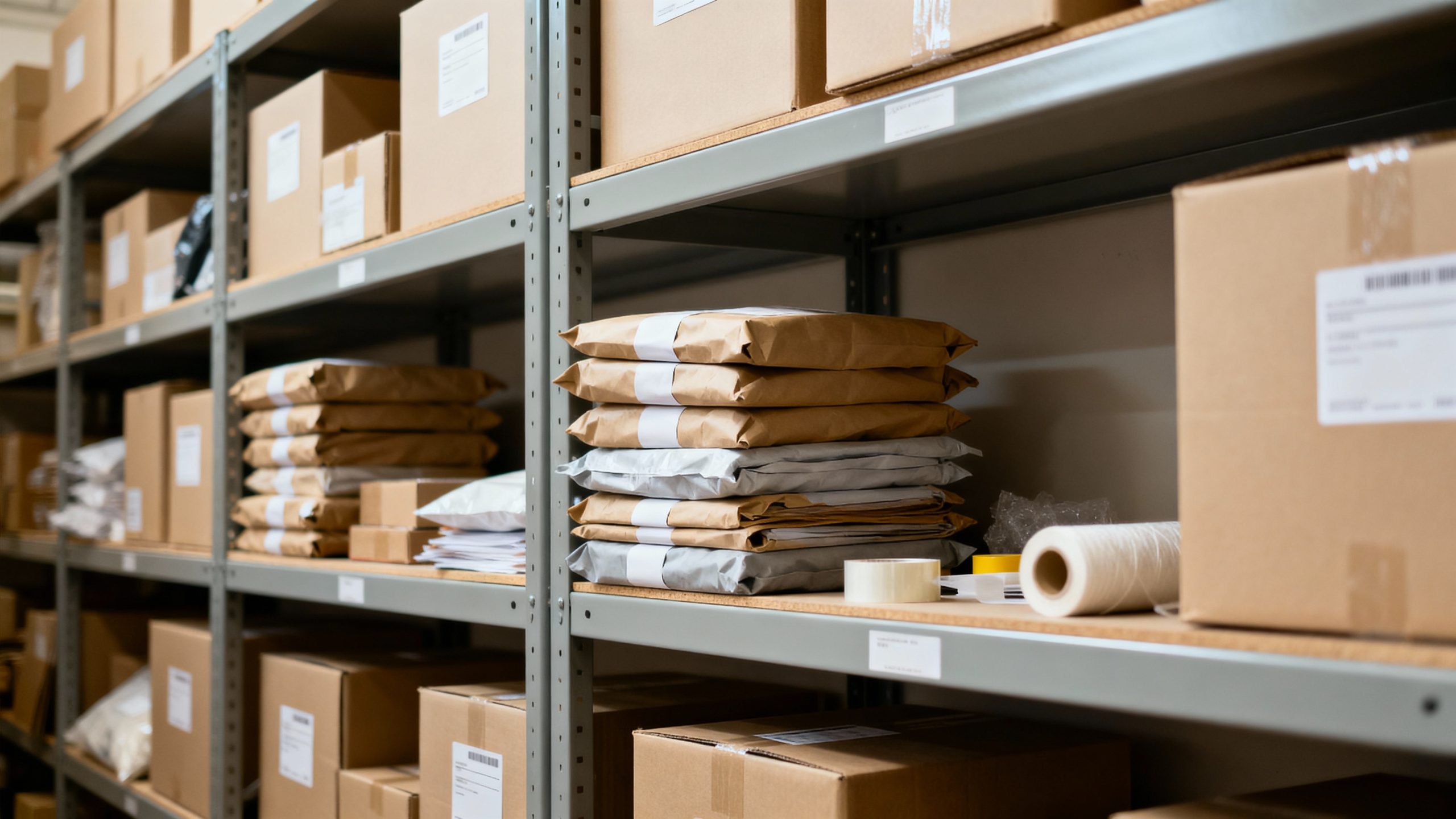
Poly mailers are the go-to choice for apparel, accessories, soft goods, and books anything that can handle a bit of flex without getting crushed. They also ship flat before use, which means a warehouse can store thousands of them in the space a stack of pre-formed boxes would need, freeing up storage for other inventory.
Types of Poly Mailers
Not all poly mailers are built the same way, and picking the right type affects both protection and cost. Here’s how the main categories break down:
- Regular poly mailers – Single-layer polyethylene film. Lightweight, inexpensive, and the standard choice for non-fragile items like clothing and soft accessories.
- Bubble/padded poly mailers (also called poly bubble mailers) – These build a bubble lining directly into the bag, giving extra cushioning without needing separate dunnage or fillers. They’re well suited to small electronics, cosmetics, or anything that needs light impact protection but doesn’t require a full box.
- Eco-friendly poly mailers – Made from recycled content rather than virgin plastic, these reduce a brand’s reliance on new polyethylene while performing nearly identically to standard mailers in terms of strength and water resistance.
- Compostable/biodegradable poly mailers – Made from plant-based materials, often a PLA+PBAT blend, and certified to recognized compost standards. They’re a strong fit for sustainability-focused brands, though they’re generally slightly less durable than virgin polyethylene and need the right end-of-life conditions to actually break down.
- Custom-printed poly mailers – Standard or eco-friendly mailers branded with a logo or design. Increasingly common among direct-to-consumer (DTC) brands that treat the unboxing moment as part of the customer experience.
Most brands don’t use just one type, a common setup pairs standard mailers for everyday orders with bubble mailers reserved for small, delicate add-ons.
Poly Mailer Sizes: How to Choose the Right Fit
Getting the size right is where poly mailers earn their cost savings too big, and you’re paying for dimensional weight you don’t need; too small, and the product won’t fit or seal properly.
Sizing formula:
- Mailer width = product width + product depth + 1 inch
- Mailer length = product length + product depth + 2 inches (to leave room for the flap and seal)
Poly mailer sizes by product type:
| Product Type | Recommended Size |
|---|---|
| Socks, accessories, thin items | 6″ x 9″ or 7.5″ x 10.5″ |
| Single shirts, light apparel | 9″ x 12″ |
| T-shirts, jeans, light jackets | 10″ x 13″ |
| Sweaters, dresses, hoodies | 12″ x 15.5″ |
| XL/XXL items, multi-item orders | 14.5″ x 19″ |
The cost-efficiency logic is straightforward: using the smallest mailer that safely fits the product minimizes both the material cost of the bag itself and the dimensional weight charge a carrier applies. There’s also a brand-presentation angle worth keeping in mind an oversized, billowing mailer looks noticeably less polished on arrival than a bag that fits the product snugly, which matters more than it might seem for repeat-purchase brands.
Poly Mailers vs. Boxes: Which Should You Use?
Poly mailers and boxes aren’t competitors so much as tools for different jobs.
Poly mailers win when you’re shipping soft, non-fragile items apparel, accessories, textiles where minimizing dimensional weight and per-unit packaging cost is the priority.
Boxes win when the product is fragile, rigid, part of a multi-item order that needs internal separation, or high enough in value that structural protection outweighs the cost savings of a mailer.
Here’s how the trade-off plays out in practice:
| Criteria | Poly Mailers | Boxes |
|---|---|---|
| Best for | Soft, non-fragile goods | Fragile, rigid, or high-value items |
| Dimensional weight impact | Minimal – bag conforms to product | Higher – extra void space often billed |
| Structural protection | Low to moderate (with padding) | High |
| Storage footprint | Small (ships flat) | Larger (pre-formed) |
| Typical cost per unit | Lower | Higher |
A concrete example: a 1lb t-shirt order shipped in a poly mailer bills close to its actual weight. The same order shipped in an oversized box can be billed at 2-3x the dimensional weight under standard carrier DIM pricing a meaningful gap once you’re shipping at volume.
Many brands don’t pick one or the other exclusively. A hybrid approach poly mailers for apparel SKUs, boxes reserved for electronics or breakables lets a single catalog use the right packaging for each product category rather than forcing everything into one format.
Sustainable Poly Mailer Options for Canadian Ecommerce Brands
Sustainability has become a real purchasing consideration for ecommerce packaging, and poly mailers now come in several greener formats.
Recycled-content poly mailers, commonly made with 50%+ post-consumer recycled material, function as a near drop-in replacement for standard mailers, with comparable durability to virgin plastic.
Compostable poly mailers are the other major sustainable option. Look for certification from a recognized body BPI (Biodegradable Products Institute) or TÜV Austria’s OK Compost mark so any sustainability claim made to customers is backed by an actual standard rather than a vague “eco” label.
The cost trade-off is real but manageable: eco-friendly options typically run 10-30% more per unit than standard poly mailers. Brands often offset that premium through the dimensional-weight savings poly mailers already provide over boxes, so the net packaging cost increase is usually smaller than the per-unit price difference suggests.
There’s a Canadian-specific wrinkle worth flagging directly: not all municipal curbside recycling programs currently accept polyethylene film, so a “recyclable” poly mailer may still need to go to a store drop-off program rather than the household bin. Compostable mailers have a parallel catch — they require access to industrial composting to break down as intended; most won’t compost properly in a backyard bin. Brands making sustainability claims should check what’s actually available to their customers before leaning too hard on end-of-life messaging.
Where to Buy Poly Mailers in Canada
Sourcing poly mailers generally comes down to three channels:
- Packaging wholesalers – Best for bulk orders. Lower per-unit pricing, but requires higher upfront spend and warehouse space to store inventory.
- Print-on-demand custom packaging suppliers – A middle ground for brands that want branded mailers without committing to wholesale minimums, though per-unit costs run higher than bulk wholesale.
- Big-box retail and office supply chains – Practical for small-quantity or one-off needs, at the highest per-unit cost of the three options.
The trade-off across all three is consistent: bulk wholesale pricing brings the lowest per-unit cost but demands more upfront capital and storage, while smaller retail-quantity purchases cost more per unit but carry no storage commitment.
For brands investing in custom poly mailers, expect minimum order quantities and lead times to vary by supplier and print complexity. Custom branding has become increasingly common among DTC brands treating the mailer itself as part of the unboxing experience rather than just a shipping container.
FAQ
What size poly mailer do I need? Measure your product’s width, length, and depth, then add roughly 1 inch to the width and 2 inches to the length to allow room for sealing. Common sizes range from 6×9 inches for small accessories up to 14.5×19 inches for bulky items like hoodies or multi-item orders matching the smallest size that safely fits your product keeps both material and shipping costs down.
Are poly mailers recyclable? Standard poly mailers are technically recyclable as polyethylene film, but most curbside recycling programs in Canada don’t currently accept them they typically need to go through store drop-off film recycling programs instead. Recycled-content and compostable poly mailers are increasingly available for brands prioritizing sustainability, though compostable versions need industrial composting facilities to break down properly.
Can poly mailers be used for fragile items? Standard poly mailers are best suited to non-fragile, soft goods like apparel and accessories rather than breakable items. Bubble or padded poly mailers add a layer of cushioning for lightly fragile items like small electronics, but rigid boxes remain the better choice for anything genuinely fragile or high-value.
How much do poly mailers cost? Standard poly mailers typically range from about $0.05 to $0.30 per unit depending on size and order quantity, with larger bulk orders bringing the per-unit cost down significantly. Eco-friendly or compostable options usually run 10-30% higher than standard mailers, and custom-printed mailers add further cost depending on design complexity and minimum order quantity.
Are poly mailers waterproof? Poly mailers are water-resistant rather than fully waterproof — the polyethylene film sheds light moisture and rain well, but prolonged submersion or heavy water exposure can compromise the seal. For products highly sensitive to moisture, an internal poly bag combined with the outer mailer adds an extra layer of protection.
What is the difference between poly mailers and bubble mailers? A standard poly mailer is a single layer of polyethylene film with no cushioning, ideal for soft, non-fragile goods. A bubble mailer (or bubble-lined poly mailer) adds an internal layer of bubble padding for extra protection, making it better suited to lightly fragile items like small electronics or cosmetics.
Do poly mailers reduce shipping costs? Yes, in most cases. Because poly mailers conform closely to the product, they keep dimensional weight close to the item’s actual weight, whereas the same product in an oversized box can be billed at 2-3 times its actual weight under carrier DIM pricing. They also weigh less than boxes, which further reduces cost on weight-based shipping rates.

- Poly Mailers for Ecommerce: The Complete Sizing & Sustainability Guid - September 22, 2026
- Purolator Shipping Guide: Rates, Tracking & Delivery Times in Canada - September 16, 2026
- How to Calculate Cubic Feet for Shipping - September 9, 2026