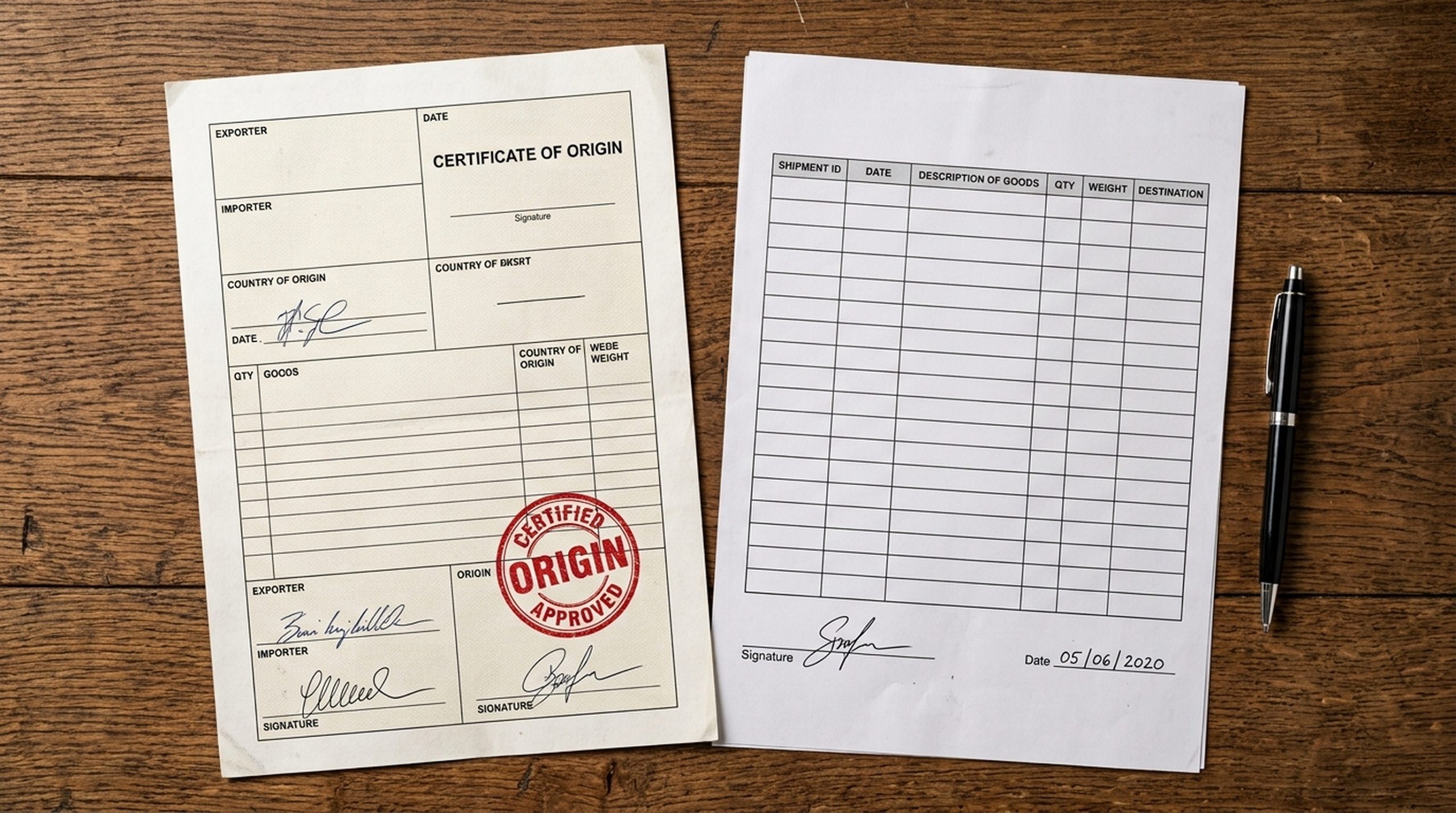
What Is a Shipping Manifest?
A shipping manifest is a detailed document that lists every item in a shipment quantities, weights, dimensions, and SKUs — along with the shipping and receiving parties, their addresses, and any special handling instructions. It’s most commonly used for bulk or international shipments moving by container, cargo ship, air, or ground, rather than for single small parcels.
Most manifests carry a tracking number and barcode that gets scanned at logistics centers, ports, and warehouses, which feeds real-time updates into a carrier’s tracking system. In short, a shipping manifest verifies exactly what was shipped, speeds up customs clearance, and gives carriers one document to scan instead of checking individual labels one by one.
Why Shipping Manifests Matter
Shipping manifests do more than record what’s in a truck or container they keep an entire supply chain moving smoothly. Customs officials rely on them to calculate duties and taxes and to enforce import regulations at the border, so an accurate manifest is often the difference between a shipment clearing quickly and one getting flagged for inspection.
On the operational side, a manifest in shipping also streamlines a carrier’s billing process and gives warehouse staff clear pick-up and delivery instructions before goods ever arrive at the dock. There’s a risk-management angle too: if goods are lost or damaged in transit, the manifest is evidence of exactly what was shipped and in what condition.
The stakes are real for smaller sellers as well. For a Canadian ecommerce seller, an incomplete manifest can mean fragile or temperature-sensitive goods get handled like any other parcel simply because the handling instructions were never captured leading to damaged inventory and unhappy customers.
Types of Shipping Manifests
Not every shipment needs the same kind of manifest. The right type depends on what’s being shipped, how it’s regulated, and how many consignments share the same vehicle or vessel.
- Cargo manifest – Itemizes all goods on a container or cargo shipment, including the nature of the goods, package count, weight, and volume. This is the most general and widely used manifest type.
- Freight manifest – Similar to a cargo manifest, but it also lists freight charges for each consignment. It’s especially useful when multiple consignments share one vehicle and need to be billed separately.
- Hazardous materials (HAZMAT) manifest – Required for regulated goods. It includes classification, packing group, and emergency response instructions so first responders know how to handle an incident.
- Import manifest – Covers goods entering Canada from abroad. The Canada Border Services Agency (CBSA) uses it to verify contents and assess duties before goods are released.
- Reefer manifest – Covers temperature-controlled shipments such as perishables or pharmaceuticals, listing the required temperature range and ventilation settings for the load.
| Manifest Type | Used For | Key Fields |
|---|---|---|
| Cargo manifest | General container or bulk cargo shipments | Goods description, package count, weight, volume |
| Freight manifest | Multiple consignments sharing one vehicle | Cargo details plus per-consignment freight charges |
| HAZMAT manifest | Regulated or dangerous goods | Hazard classification, packing group, emergency instructions |
| Import manifest | Goods entering Canada from abroad | Contents, value, duty and customs details |
| Reefer manifest | Temperature-controlled or perishable goods | Required temperature, ventilation, handling notes |
Most Canadian ecommerce sellers won’t deal with a full cargo manifest day-to-day. Sellers using a carrier’s sending portal — Canada Post, Purolator, or Canpar — typically generate a simplified daily manifest or scan form instead, which covers the same core purpose at a much smaller scale.
What Goes On a Shipping Manifest
While the exact layout varies by carrier, a standard shipping manifest generally includes the same core fields:
- Description of goods
- Quantities and weights
- Consignor and consignee details (names and addresses)
- Origin and destination
- Freight charges
- Carrier and vehicle information
- A document or tracking number
Here’s a simplified shipping manifest example showing how those fields typically come together for a Canadian ecommerce seller batching several orders for pickup:
| Item | SKU | Quantity | Weight | Destination |
|---|---|---|---|---|
| Ceramic mug set | MUG-1042 | 24 | 18 kg | Toronto, ON |
| Cotton hoodie | HD-2201-M | 40 | 32 kg | Calgary, AB |
| Phone case bundle | PC-330 | 60 | 6 kg | Vancouver, BC |
This is a useful starting point if you’re looking for a shipping manifest template to adapt for your own batching process. Specialized manifests — HAZMAT, out-of-gauge, or reefer — include all of these general fields plus the category-specific details covered in the Types section above. The document or tracking number on the manifest is what ties back to the barcode scanning process described earlier: each scan at a port, warehouse, or logistics center updates the shipment’s status against that single number.
Shipping Manifest vs. Similar Shipping Documents
Shipping manifests are often confused with other logistics paperwork, so it helps to see them side by side. One of the most common comparisons — bill of lading vs shipping manifest — comes up because both documents travel with freight, but they serve very different purposes.
| Document | Purpose | Issued By | Covers |
|---|---|---|---|
| Shipping manifest | Full inventory of everything on a vehicle or vessel | Carrier or shipper | Every shipment on board |
| Bill of Lading (BOL) | Legal contract between shipper and carrier | Carrier | One specific shipment |
| Commercial invoice | Bill from seller to buyer showing price and payment terms | Seller | One transaction |
| Packing list | Details what’s inside one specific package | Shipper | A single package |
| Certificate of origin | Certifies where goods were manufactured | Exporter or chamber of commerce | Country of origin for customs |
A Bill of Lading is a legal contract between shipper and carrier issued per shipment, while a manifest is the broader inventory covering every shipment loaded onto that vehicle or vessel. A commercial invoice is a bill from seller to buyer showing price and payment terms — it has nothing to do with the manifest’s role as a shipping record. A packing list details what’s inside one specific package, while a manifest summarizes an entire load across many packages. And a certificate of origin certifies where goods were manufactured; it’s a customs document that often travels alongside a manifest but doesn’t replace it.
How Canadian Ecommerce Sellers Create a Shipping Manifest
Most Canadian sellers don’t build a manifest from scratch — they generate one directly inside their carrier’s shipping portal (Canada Post’s Snap Ship, Purolator’s system, or Canpar Online) after batching their day’s orders for pickup.
- Select shipments ready for dispatch. Batch every order that’s packed and ready to go out that day.
- Review order details. Confirm quantities, weights, and destinations match what’s actually been packed.
- Generate the manifest or scan form. The portal compiles the batch into a single document with a tracking reference.
- Hand the manifest to the driver. Provide the printed or digital copy at pickup so it can be scanned against the physical shipment.
For sellers shipping across multiple carriers, shipping software and multi-carrier platforms can auto-generate a manifest across several carriers in one batch, which saves significant time during high-volume periods like holiday sales. The most common error to watch for is a mismatched piece count between the manifest and what’s physically handed to the driver — this alone is enough to delay pickup scanning.
Common Shipping Manifest Challenges and Solutions
Even a well-run shipping operation runs into manifest issues occasionally. Here’s how the most common ones show up, and how to prevent them.
Errors in manifest details. Mistakes in quantities, weights, or addresses can trigger customs holds, delayed pickups, or extra fees. Build in a double-check step before dispatch so errors are caught before the shipment leaves the building.
Amending a submitted manifest. It’s usually possible to amend a manifest after submission, but the process typically requires a corrector document and may carry a penalty fee. Accuracy up front matters far more than relying on a later correction.
Discrepancies between manifest and actual shipment. When the manifest doesn’t match what’s physically loaded, the root cause is usually a picking or packing error further back in the process. A warehouse-side count reconciliation before pickup is the most reliable fix.
Language and terminology barriers in cross-border shipping. Manifests that cross international borders need to be understood by carriers and customs officials in the destination country. Using standardized Incoterms and HS codes — rather than informal descriptions — keeps everyone reading from the same page. If you’re not familiar with these codes, our guide on what HS codes are covers how they show up on a manifest.
FAQ
What is a shipping manifest used for? A shipping manifest gives carriers, customs officials, and warehouse staff a single, accurate record of everything in a shipment. It confirms quantities and contents against the original order, supports customs clearance and duty calculation, provides pickup and handling instructions, and serves as evidence if goods are lost or damaged in transit. For Canadian ecommerce sellers shipping in bulk or internationally, a correctly filled-out manifest speeds up both pickup and border crossing.
Is a shipping manifest the same as a bill of lading? No. A shipping manifest lists all the cargo on a vehicle or vessel across every shipment it’s carrying, while a bill of lading (BOL) is a legal contract between the shipper and carrier issued for one specific shipment. A single truck or container might be covered by one manifest but several individual bills of lading, one for each consignment on board.
Do I need a shipping manifest for small parcels? Most small parcel and single-package ecommerce shipments don’t require a formal cargo manifest. However, carriers like Canada Post, Purolator, and Canpar generate a simplified daily manifest or scan form when a seller batches multiple parcels for pickup, which speeds up the handover process. Bulk, freight, and international container shipments are where a full shipping manifest becomes a legal requirement.
What happens if a shipping manifest has an error? An incorrect or incomplete shipping manifest can lead to shipment delays, additional customs inspection, fines, or disputes with the receiver. If an error is found, contact the shipping agent or carrier immediately — correcting it before the shipment departs is far easier than amending it once it’s en route.
Can a shipping manifest be amended after submission? Yes, a submitted manifest can usually be amended, but the process typically involves filing a manifest corrector document or an online submission before the shipment or vessel reaches its destination. Amendments often come with a processing fee, so it’s worth double-checking manifest details before submission rather than relying on later corrections.
Are shipping manifests publicly accessible? Generally, no. Shipping manifests are shared with customs authorities, port or terminal operators, and the shipping carrier, but they’re not typically available to the general public. This differs from some import/export trade data, which can be aggregated and published in anonymized form by trade research firms.
What information goes on a shipping manifest? A standard shipping manifest includes a description of the goods, quantities and weights, consignor and consignee names and addresses, origin and destination, freight charges, carrier and vehicle information, and a document or tracking number. Specialized manifests — hazardous materials, out-of-gauge, or reefer — add category-specific fields such as emergency response details or temperature requirements.
Key Takeaways
- A shipping manifest is the master record of everything in a shipment — quantities, weights, parties, and handling instructions.
- Manifest types vary by shipment: cargo, freight, HAZMAT, import, and reefer manifests each serve a different purpose.
- A manifest is not the same as a bill of lading, commercial invoice, packing list, or certificate of origin — each plays a distinct role.
- Most Canadian ecommerce sellers generate a simplified daily manifest or scan form through their carrier’s portal (Canada Post, Purolator, Canpar) rather than a full cargo manifest.
- Accuracy before dispatch is the best defense against customs holds, delayed pickups, and amendment fees.
Getting your manifest right the first time keeps shipments moving and customers happy. If you’re managing pickups across multiple carriers, see our guide on scheduling a pickup for how manifest generation fits into your day-to-day workflow.

- What Is Air Small Packet Shipping? A Guide for Canadian Sellers - October 1, 2026
- Poly Mailers for Ecommerce: The Complete Sizing & Sustainability Guid - September 22, 2026
- Purolator Shipping Guide: Rates, Tracking & Delivery Times in Canada - September 16, 2026